


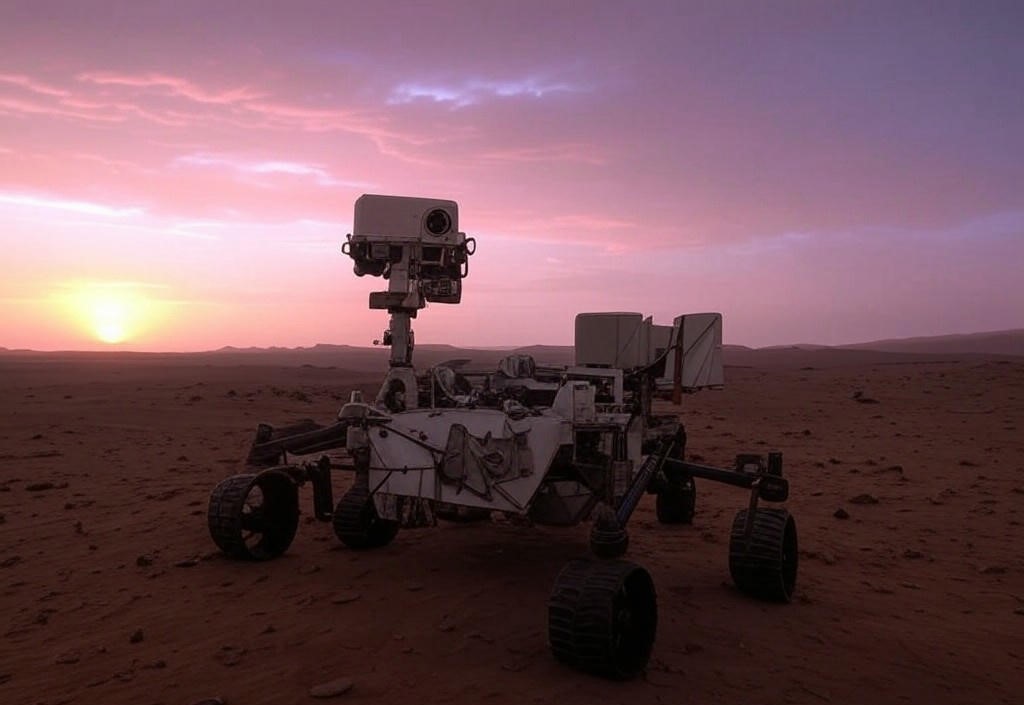
While the Martian mists might seem to be the thoughtful found in Earth’s skies, they incorporate frozen carbon dioxide, or dry ice.
Red-and-green-colored mists float through the Martian sky in another arrangement of pictures caught by NASA’s Interest wanderer utilizing its Mastcam — its fundamental arrangement of “eyes.” Assumed control north of 16 minutes on Jan. 17 (the 4,426th Martian day, or sol, of Interest’s central goal), the pictures show the most recent perceptions of what are called noctilucent (Latin for “late evening sparkling”), or dusk mists, touched with variety by dissipating light from the sunset.
At times these mists even make a rainbow of varieties, delivering glowing, or “mother-of-pearl” mists. Excessively weak to be found in light, they’re just apparent when the mists are particularly high and night has fallen.
Martian mists are made of either water ice or, at higher heights and lower temperatures, carbon dioxide ice. (Mars’ environment is over 95% carbon dioxide.) The last option are the main sort of mists saw at Mars delivering glow, and they should be visible close to the highest point of the new pictures at a height of around 37 to 50 miles (60 to 80 kilometers). They’re likewise apparent as white crest falling through the environment, going as low as 31 miles (50 kilometers) over the surface prior to vanishing in view of climbing temperatures. Showing up momentarily at the lower part of the pictures are water-ice mists going the other way around 31 miles (50 kilometers) over the wanderer.
Dawn of Twilight Clouds
Twilight mists were first seen on Mars by NASA’s Pathfinder mission in 1997; Interest didn’t recognize them until 2019, when it gained its first-at any point pictures of glow in quite a while. This is the fourth Mars year the wanderer has noticed the peculiarity, which happens during late-summer in the southern side of the equator.
Mark Lemmon, an environmental researcher with the Space Science Foundation in Stone, Colorado, drove a paper summing up Interest’s initial two times of sundown cloud perceptions, which distributed before the end of last year in Geophysical Exploration Letters. “I’ll continuously recall whenever I first saw those brilliant mists and made certain at first it was some variety curio,” he said. “Presently it’s become unsurprising to the point that we can design our shots ahead of time; the mists appear at the very same season.”
Each locating is a potential chance to get familiar with the molecule size and development rate in Martian mists. That, thus, gives more data about the planet’s air.
Cloud Secret
One major secret is the reason dusk mists made of carbon dioxide ice haven’t been seen in that frame of mind on Mars. Interest, which arrived in 2012, is on Mount Sharp in Storm Pit, only south of the Martian equator. Pathfinder arrived in Ares Vallis, north of the equator. NASA’s Steadiness meanderer, situated in the northern half of the globe’s Jezero Hole, hasn’t seen any carbon dioxide ice dusk mists since its 2021 landing. Lemmon and others suspect that specific locales of Mars might be inclined toward framing them.
A potential wellspring of the mists could be gravity waves, he said, which can cool the climate: “Carbon dioxide was not supposed to consolidate into ice here, so something is cooling it to the point that it could work out. However, Martian gravity waves are not completely perceived and we’re not altogether certain what is making sundown mists structure in one spot yet not another.”
Mastcam’s Halfway View
The new sundown mists seem outlined in a somewhat open circle. That is on the grounds that they were taken utilizing one of Mastcam’s two variety cameras: the left 34 mm central length Mastcam, which has a channel wheel that is stuck between positions. Interest’s group at NASA’s Stream Drive Research facility in Southern California stays ready to utilize both this camera and the higher-goal right 100 mm central length camera for variety imaging.
The meanderer as of late wrapped an examination of a spot called Gediz Vallis channel and is en route to another area that incorporates boxwork — cracks shaped by groundwater that seem to be goliath spiderwebs when seen from space.
All the more as of late, Interest visited an effect cavity nicknamed “Natural Ravine,” catching it in pictures and concentrating on the organization of rocks around it. The cavity, 67 feet (20 meters) in measurement, is shallow and has lost quite a bit of its edge to disintegration, demonstrating that it probably framed a long time prior. One explanation Interest’s science group concentrates on cavities is on the grounds that the cratering system can uncover long-covered materials that might have preferred protected natural particles over rocks presented to radiation at the surface. These particles give a window into the old Martian climate and how it might have upheld microbial life billions of years prior, if any consistently shaped on the Red Planet.
More About Interest
Interest was worked by NASA’s Stream Drive Research facility, which is overseen by Caltech in Pasadena, California. JPL drives the mission for NASA’s Science Mission Directorate in Washington. Malin Space Science Frameworks in San Diego assembled and works Mastcam.